Cupping Therapy · Knoxville, TN
Cupping Therapy in Knoxville, TN
Silicone & Glass Cupping, Added to Deep Tissue · Licensed Knoxville LMTs · 1,500+ 5-star Google reviews · Best of Knoxville 2026
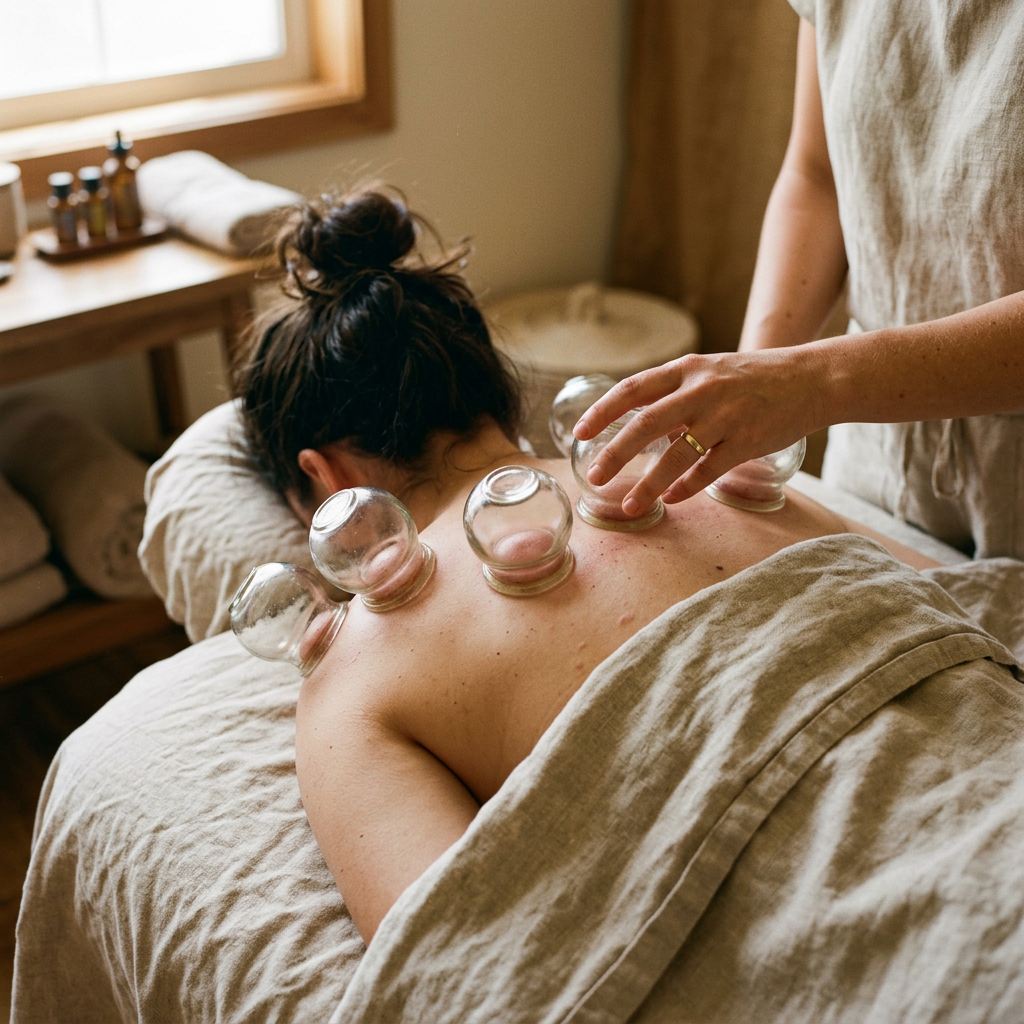
Cupping therapy at Healing Hands Spa is dry, non-piercing suction cupping that a Tennessee-licensed massage therapist adds to a deep tissue or therapeutic massage at our two Knoxville locations, using modern silicone suction-pump cups and traditional glass cups to draw tight tissue gently upward. You can book it at our Farragut spa on Kingston Pike near Turkey Creek or our Cedar Bluff spa off I-40 exit 378.
Here we run cupping as part of a real massage: silicone cups versus glass, how the cupping add-on rides inside the hands-on work, whether cupping hurts, what the marks are, who should skip it, and how to book at either location. Most guests add cupping to a 60- or 90-minute deep tissue or therapeutic session because the skilled hands-on work is where the stronger benefit sits and the cups are one comfortable step folded in.
One honest note before you book. Cupping is a traditional comfort practice with limited scientific evidence behind it, not a medical treatment, and it complements massage, rest, hydration, and sleep rather than replacing any of them or your doctor. If you want the first-principles basics of what cupping is, start with our cupping guide; if your interest is athletic recovery or everyday tension, two recovery pages go deeper on those. Here we stay focused on the technique and the booking.
Silicone Cupping & Glass Cupping in Knoxville
We use both modern silicone suction-pump cups, which are gentler and easy to glide, and traditional glass cupping for stronger static holds. Your licensed therapist matches the tools to your goals at intake.
Cupping Add-On to Deep Tissue
Most guests book cupping with deep tissue in Knoxville: a 60- or 90-minute session where we warm up the tissue by hand, decompress the tight spots with cups, then integrate by hand. The massage carries the appointment.
Does Cupping Hurt? No.
Cupping should not be painful. You feel a firm pull or a deep stretch from inside the muscle, not a sharp or burning pain. If anything ever feels too intense, your therapist eases or removes the suction immediately.
Honest About Cupping Marks
Cupping can leave round pink-to-purple marks where the cups sit. They are pooled blood from tiny ruptured capillaries, the same biology as a bruise, not toxins, and they typically fade in 3 to 7 days.
Licensed Cupping Therapist in Knoxville
Every cupping session is performed by a Tennessee-licensed massage therapist trained in safe placement and suction, with dry, non-piercing cupping only and equipment sanitized between every guest.
Two Knoxville Locations
Book cupping therapy at our Farragut spa (10935 Kingston Pike) or Cedar Bluff spa (9621 Countryside Center Ln). Both are 4.8 stars across 1,500+ 5-star Google reviews and Best of Knoxville 2026.
How Healing Hands does cupping therapy in Knoxville
Cupping is the request we hear most as a massage add-on at both Knoxville spas, and the way we run it is specific enough to be worth spelling out. We do dry, non-piercing cupping only, performed by a Tennessee-licensed massage therapist, and we fold it into a real massage rather than selling it as a quick standalone gimmick. The short reason is that the skilled hands-on work is where the stronger benefit sits, and the cups are one satisfying step inside that.
If you want the plain-English basics of what cupping even is and where it comes from, our cupping guide covers that ground. The walkthrough here is for guests past the what-is-it stage who want to know how we do it on the table and how to book.
Silicone cupping vs glass cupping in Knoxville
The two tools you have seen online are both on our carts, and they do different jobs. We will often use both in one session: silicone to warm up and glide, glass to hold and release on the stubborn spots. Your therapist decides the mix based on where you are tight and how your skin and tissue respond, and they will explain the choice before any cup goes on.
Neither tool pierces the skin. The difference is in feel, glide, and how focused the suction is, not in whether the technique is safe.
When we reach for silicone suction-pump cups
Silicone suction-pump cups are softer and lighter, and a therapist creates the suction with a small hand pump after the cup is on your skin. Because they slide easily over oiled skin, they are the natural choice for moving-cup work and for broad areas like the back, the IT bands, and the shoulders.
Best for first-timers and large areas
If this is your first time, silicone is usually where we start. The suction is easy to dial in and easy to ease off, and the gliding stroke feels like a slow, deep massage in reverse rather than a fixed, intense hold. For a broad, achy upper back after a desk week, silicone moving cups cover a lot of ground comfortably.
When we reach for traditional glass cups
Traditional glass cupping, the kind you have seen on Olympic swimmers, creates a stronger, more focused pull and is left in place for a few minutes at a time. It shines on stubborn static spots, the upper traps, the band between the shoulder blades, and along the spine, where a steady, concentrated hold helps tight tissue let go.
Best for stubborn static holds
When one knot has not budged with hands alone, a glass cup held over it gives a deeper, localized decompression than a gliding silicone cup. We keep the suction at your comfort, not at a fixed setting, and we check in while the cup sits. The goal is a satisfying tug that eases as the muscle relaxes, never a sensation you have to grit through.
Cupping with deep tissue: the add-on protocol
The way most of our regulars use cupping is as an add-on to a 60- or 90-minute deep tissue or therapeutic massage, and there is a simple, repeatable protocol behind it. The cups are one step of several, which is exactly the point. You leave having had a full massage, with cupping woven in, not ten minutes of suction billed as recovery.
Desk workers tend to want the focus on the upper back, neck, and shoulders; people carrying low-back and hip tension lean toward the glutes and lower back. We build the zones around where you actually hold tension, which we sort out at intake.
The four-step cupping add-on flow
Almost every cupping-with-deep-tissue session at Healing Hands follows the same arc. The cups land in the middle, after warm-up and before the final hands-on integration, so they are part of the bodywork rather than the whole thing.
Warm-up by hand
Ten to fifteen minutes of hands-on massage to bring blood to the area and loosen the surface tissue before any cups go on. Cold, guarded muscle does not respond well to suction, so we never start cold.
Decompress with cups
Silicone or glass cups placed on the tightest zones, left to sit for a few minutes or glided across oiled skin for a moving-cup stroke. This is where you feel the deep-stretch pull, the tissue drawn gently up instead of pressed down. Suction is dialed to your comfort.
Integrate by hand
Your therapist returns by hand to work through everything the cupping decompressed, blending it into the rest of the massage so you leave with a finished, cohesive session rather than a patchwork of cup marks.
Aftercare at home
Drink some extra water, keep the cupped area warm and covered, and skip the hot tub, sauna, and a hard workout for about 24 hours. None of it is medicinal; it just helps you feel your best and keeps fresh marks from showing where you would rather they did not.
Does cupping hurt, and what are the cupping marks?
These two questions come up at the front desk more than any others, and both have honest, plain answers. Cupping should not hurt, and the marks are not what the internet photos claim. Getting both straight before you book is part of why our guests come back.
We talk through both at intake, and we will show you exactly where cups would go so there are no surprises.
Does cupping hurt? What the pull actually feels like
No, cupping should not hurt. The sensation is firm and unfamiliar the first time, but most guests describe it as a deep, satisfying stretch from inside the muscle, not a sharp or burning pain. With moving-cup technique, silicone cups glided across oiled skin, it feels like a slow, deep massage stroke in reverse. Static cups left in place settle into a steady, calm tug that eases as the muscle relaxes.
Suction is adjustable, and we keep it at your edge rather than past it. If anything ever feels too intense, your therapist eases the suction or removes the cup immediately. You are never meant to suffer through it.
What cupping marks really are (pooled blood, not toxins)
Plenty of places get this wrong, so here is the correction we give every guest at intake. The round marks are not toxins or metabolic waste being pulled out of the body. They are pooled blood: the suction lifts the skin and surface tissue, a few tiny capillaries underneath rupture, and a little blood leaks into the surrounding tissue. The flat, round patch you see afterward, pink to purple, is the same basic biology as a bruise, made by negative pressure instead of a knock. Our cupping guide breaks down that capillary biology at more length if you want it.
There is no mechanism by which a cup draws toxins through intact skin, and the federal cupping fact sheet describes the marks as temporary discoloration, not a detox event. They look more dramatic than they feel and are usually not tender afterward. If a clinician ever sees them without context, mention the cupping so symmetrical round patches are not misread.
How long cupping marks last, and timing around events
Cupping marks typically fade in 3 to 7 days, faster on some areas of the body than others. They clear on their own and need no special treatment to disappear. We always talk through placement before we start, so if you have a wedding, photoshoot, or beach trip on the calendar we can stay off visible areas or skip cupping entirely that visit.
If timing matters for photos, book your session at least 7 to 10 days ahead so the marks have room to clear. Wear or bring a loose, dark-colored top after a session, since marks can show through thin or light fabric for the first day.
The Olympic cupping marks you've probably seen
If you first noticed cupping on television, you are in good company. At the 2016 Rio Olympics, swimmer Michael Phelps and several other athletes showed up with rows of dark, round marks across their shoulders and backs, and overnight everyone wanted to know what they were. That image put cupping in front of more people than any study ever has.
Here is the honest read on it. A decorated Olympian using cupping made it famous; it did not make it proven. One high-profile athlete trying something is not evidence that it improves performance, and the federal research we rely on still lists no conditions cupping treats. The marks on Phelps were the same thing the marks on our guests are: pooled blood from light suction, like a bruise, gone in a week or so. If those Olympic photos are what made you curious, that curiosity is welcome here, and you will get the same straight answer we give everyone.
Cupping safety: who it's for and who should skip it
Cupping suits curious, generally healthy people who are sore but not injured, and it is a reasonable thing to try if that is you. It is not appropriate for everyone, though, and a short list of conditions are real reasons to skip it. We sort out which group you are in at intake, and we would rather decline a booking than do cupping on someone who should not have it.
Cupping is honestly a low-evidence comfort practice, not a medical treatment, so it should never replace or delay real care. For an actual injury or illness, see a medical provider first.
Who books cupping therapy at our Knoxville spas
Most of our cupping guests fall into a few groups, and if you see yourself here, you are the kind of person we plan these sessions around. The common thread is ordinary tension or soreness, not an injury.
Two sibling pages go deeper on specific situations and own those angles, so we point you to them rather than repeat them here.
The people we most often cup
These are the guests who tend to get the most out of a cupping-with-deep-tissue session at Farragut or Cedar Bluff.
Desk workers with chronic neck and shoulder tension
Long hours at a keyboard build chronic tightness through the upper traps, neck, and mid-back. Many desk-worker guests find cupping reaches that tightness in a way hands-on work alone doesn't quite get to, which is why people from Bearden, West Hills, and the West Town Mall area are some of our most frequent cupping guests.
Athletes, and curious first-timers
Runners, lifters, and weekend athletes who are sore from training use cupping to feel looser between efforts; our athletic-recovery cupping page covers that lane in depth. Cautious first-timers who just want a straight answer and a licensed, professional first experience also land here, and our everyday-recovery page is written with them in mind.
Who should not get cupping
Some people should not get cupping at all. The clearest reasons come straight from safety guidance, and they matter because suction breaks tiny surface vessels by design, so anything that affects bleeding, skin integrity, or healing changes the risk picture. Tell us your medications and conditions at intake, and check with your own physician when you are unsure.
Separate from the list below, one firm rule for everyone: do not put cups over a fresh injury, and do not let cupping delay real care. See a medical provider for an actual strain, sprain, or illness.
A plain list of contraindications
Here is the short version of who we screen out at intake. Our cupping guide carries the full explanation behind each one; this is what we run through before the first cup goes on.
Blood thinners and bleeding disorders
On a blood thinner, or living with a bleeding or clotting disorder? Cupping waits until your physician clears it. Because the suction is meant to rupture small vessels, anything that raises bleeding deepens the marks and the risk along with them.
Fragile, broken, or infected skin
We need intact, healthy skin under the cup. Anywhere fragile, broken, infected, or carrying an open wound is off-limits, so we route around it or hold off entirely that day.
Eczema or psoriasis flares
Suction can aggravate an eczema or psoriasis flare, so cups stay clear of any flaring patch. Flag a skin condition at intake and we plan around it.
Pregnancy and fresh injuries
If you are pregnant, tell us and clear it with your provider first, since some placements are not appropriate. And a fresh strain, sprain, or acute injury needs assessment and rest or care, never a cup.
Dry cupping only, by licensed Knoxville LMTs
Every cupping session at Healing Hands is dry and non-piercing, performed by a Tennessee-licensed massage therapist. Dry cupping does not pierce the skin. We do not offer wet cupping, which cuts the skin to draw blood, and we never will. If any provider cannot tell you plainly which one they do, settle that question before anything else.
Equipment is sanitized between every guest. That is not an upsell. Because suction alone can leave trace blood on the gear even in dry cupping, cleaning it between clients is basic safety, exactly the practice the federal fact sheet stresses to prevent any spread of bloodborne illness.
Pricing, booking, and both Knoxville locations
Cupping is priced by session length and whether it is added to a massage or booked as a focused session, plus any seasonal specials, so the most accurate quote comes from a quick phone call. Our front desk will give you the exact rate and book you with a therapist who is taking new cupping clients this week.
Both spas run the same therapist standards, the same dry-cupping-only policy, and the same sanitation between guests. If you have been searching for cupping near you in West Knoxville, pick whichever location is the shorter drive.
Cupping pricing and how to book
For current cupping rates, add-on pricing, and which therapists at each location are taking new cupping clients, call Farragut at (865) 671-3200 or Cedar Bluff at (865) 236-0880. You can also book online through our scheduler at go.booker.com.
Booking ahead is best, since cupping add-ons fill our therapeutic-massage slots quickly, especially on Saturdays and in the 11am to 3pm midday window. If you have been carrying tension for weeks, pair cupping with a 90-minute deep tissue rather than a single 60-minute add-on; one short add-on rarely catches months of buildup. Both locations are open Monday through Saturday 10am to 8pm and Sunday 1pm to 8pm.
Cupping therapy at Farragut and Cedar Bluff
Both spas sit in West Knoxville, so the right one is simply whichever is the shorter trip. The details for each are below.
Cupping therapy in Farragut (Turkey Creek, Hardin Valley, Kingston Pike)
Our Farragut spa is at 10935 Kingston Pike, Knoxville, TN 37934, near the Turkey Creek corridor and an easy run from Hardin Valley and the western Kingston Pike stretch. It is about 5 minutes from Hardin Valley and a quick exit off I-40 westbound.
Hours, phone, and parking
Open Monday through Saturday 10am to 8pm and Sunday 1pm to 8pm. Call (865) 671-3200 with any cupping questions before you book, and grab one of the pull-up spots right in front, no garage and no stairs.
Cupping in Cedar Bluff (Bearden, West Hills, off I-40 exit 378)
Our Cedar Bluff spa is at 9621 Countryside Center Ln, Knoxville, TN 37931, about a minute off I-40 exit 378 and usually the quicker trip from Bearden, West Hills, the West Town Mall area, and the UT campus side of town.
Hours, phone, and parking
Same hours as Farragut: Monday through Saturday 10am to 8pm and Sunday 1pm to 8pm. Call (865) 236-0880 to ask about availability or anything on the safety list, and use the quiet shared lot off Countryside Center Ln.
Where our cupping claims come from
The honest framing here comes from the federal research agency, not from us. The National Center for Complementary and Integrative Health (NCCIH) cupping fact sheet at nccih.nih.gov/health/cupping makes no efficacy claims for cupping and lists no conditions it treats; most of it covers safety, including the marks and contraindications. We lean on it deliberately so the claims here are attributable rather than something a spa simply asserts.
NCCIH is part of the National Institutes of Health and provides this material for general education, not medical advice. If you take medication, are pregnant, have a skin condition, or bruise or bleed easily, talk it through with your own clinician before trying cupping, and see a medical provider for any actual injury or illness.
Keep exploring
Cupping explained: the plain-language Knoxville guide Cupping for athletes and muscle recovery Top-rated cupping recovery for everyday tension Deep tissue massage, where the stronger benefit sits Add an infrared sauna session to finish your visit Foot massage and reflexology in Knoxville See the full Healing Hands service menu Farragut and Cedar Bluff locations and hours
Book Cupping Therapy in Knoxville
Cupping therapy in Knoxville at Farragut & Cedar Bluff. Silicone & glass cupping added to deep tissue, by licensed LMTs. Honest about the marks. Book today.
Book Farragut Book Cedar Bluff
Cupping is offered as an add-on or focused session at either location — Mon–Sat 10am–8pm, Sun 1pm–8pm.
Our Knoxville Locations
Healing Hands Spa — Farragut
10935 Kingston Pike, Knoxville, TN 37934
West Knoxville · Kingston Pike near Turkey Creek
Mon–Sat 10am–8pm • Sun 1pm–8pm
Healing Hands Spa — Cedar Bluff
9621 Countryside Center Ln, Knoxville, TN 37931
Central Knoxville · I-40 / I-75 exit 378
Mon–Sat 10am–8pm • Sun 1pm–8pm
Cupping Therapy in Knoxville, TN — Common Questions
Does cupping therapy hurt?
No, cupping should not hurt. Most guests describe the sensation as a firm, deep stretch from inside the muscle, unusual the first time but not a sharp or burning pain. With moving-cup technique, silicone cups glided across oiled skin, it feels like a slow, deep massage stroke in reverse. Your therapist adjusts the suction to your comfort and keeps it at your edge, not past it. If anything ever feels too intense, they ease or remove the suction immediately.
What about the circular cupping marks, are those bruises or toxins?
They are not toxins. Cupping marks are pooled blood from tiny ruptured capillaries, the same basic biology as a bruise, produced by suction instead of impact. When the cup pulls the skin and surface tissue upward, it ruptures tiny vessels just beneath the surface and a little blood leaks into the surrounding tissue, leaving a flat, round patch of discoloration. There is no mechanism by which a cup draws toxins through intact skin. The marks look more dramatic than they feel, are usually not tender afterward, and typically fade in 3 to 7 days.
Do you offer silicone cupping or traditional glass cupping in Knoxville?
Both. Our Tennessee-licensed therapists use modern silicone suction-pump cups for gentler first sessions and moving-cup work, and traditional glass cupping for stronger static holds on stubborn knots. Many sessions use a combination: silicone to warm up and glide, glass to hold and release on the tightest spots. Neither pierces the skin. Your therapist matches the tools to your goals at intake.
Can I add cupping to a deep tissue or therapeutic massage?
Yes, and that is how most of our Knoxville guests book it. Cupping with deep tissue runs as a 60- or 90-minute session where your therapist warms up the tissue by hand, decompresses the tight spots with cups, then comes back by hand to integrate everything. The hands-on massage carries the appointment, and the cups are one comfortable step folded in, which is the most effective way we have found to use them for stubborn chronic tension.
How long does a cupping session take, and how much does it cost?
When added to a massage, cupping usually adds 15 to 30 minutes of focused work to your 60- or 90-minute session. Pricing depends on session length and whether cupping is an add-on or a focused session, plus any seasonal specials, so the most accurate quote comes from a quick call. Reach Farragut at (865) 671-3200 or Cedar Bluff at (865) 236-0880 and the front desk will give you the exact rate and book you in.
Who should NOT get cupping therapy?
Cupping is not appropriate if you take blood thinners or have a bleeding or clotting disorder, have fragile or broken skin, have an active skin infection or open wound in the area, or have eczema or psoriasis flaring where cups would go, since cupping can worsen those. Certain placements are not appropriate during pregnancy. Never put cups over a fresh injury. Tell your therapist your medications and conditions at intake, check with your physician when in doubt, and see a medical provider for any actual injury or illness rather than letting cupping delay care.
Is cupping at Healing Hands dry or wet cupping, and are your therapists licensed?
We offer dry, non-piercing cupping only, performed by Tennessee-licensed massage therapists, with equipment sanitized between every guest. Dry cupping does not pierce the skin. Wet cupping cuts the skin to draw blood and carries heavier risks; we do not offer it and never will. Cleaning the gear between clients is basic safety, since suction alone can leave trace blood even in dry cupping.
Does cupping actually work, or is it hype?
Honestly, the high-quality evidence is largely missing. The NCCIH cupping fact sheet, from the federal agency that studies practices like this, lists no conditions cupping treats and cites no trials showing it works, and most of it is about safety. We treat cupping as a low-evidence traditional comfort practice that complements massage, rest, hydration, and sleep, not a medical treatment. Many guests find a session leaves them feeling looser and more relaxed, which is a real experience and a fine reason to book it, but it is not a proven medical effect, and we keep that distinction clear.
How should I take care of my skin after a cupping session?
Drink some extra water for the rest of the day, keep the cupped area warm and covered, and skip hot tubs, saunas, and intense workouts for about 24 hours. The marks themselves need no special treatment and fade on their own in 3 to 7 days. None of this is medicinal; it is comfort guidance. If you have a wedding, photoshoot, or beach trip coming up, cover the marks with a loose, darker top, and book at least 7 to 10 days ahead so they have time to clear, or ask us to stay off visible areas that visit.
More on Cupping & Recovery in Knoxville
Cupping Explained: A Knoxville Guide Best Cupping for Recovery in Knoxville, TN Top-Rated Cupping Recovery in Knoxville, TN
Sources & further reading
Independent, non-commercial information on massage and wellness from the NIH's National Center for Complementary and Integrative Health (NCCIH), Mayo Clinic, and the American Massage Therapy Association:
Last updated